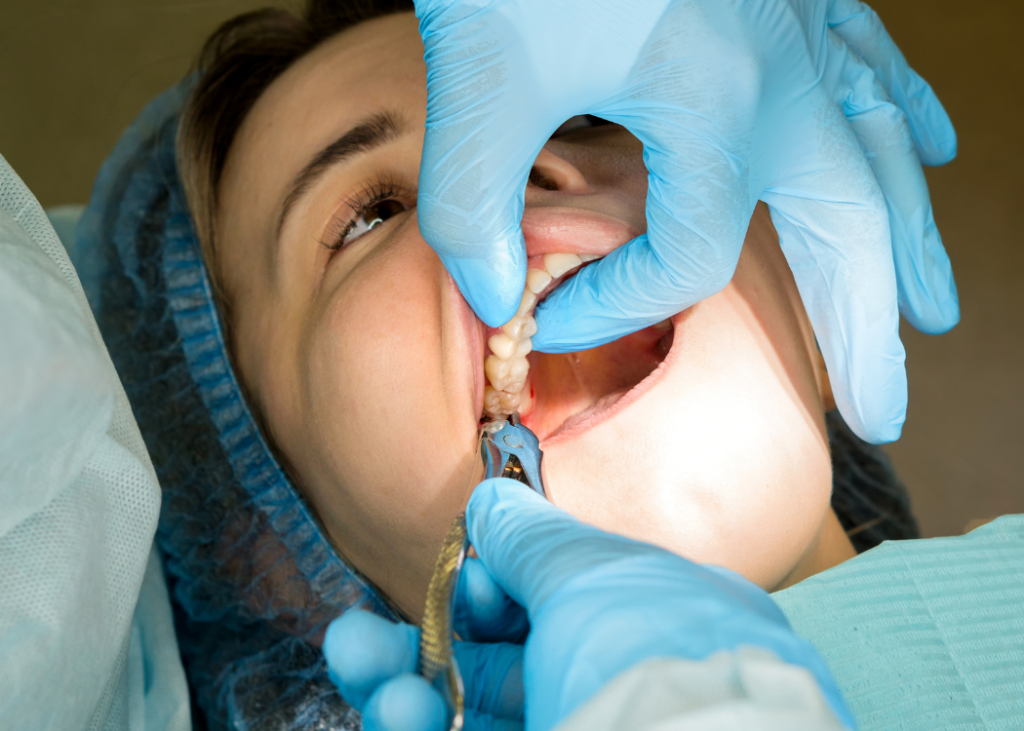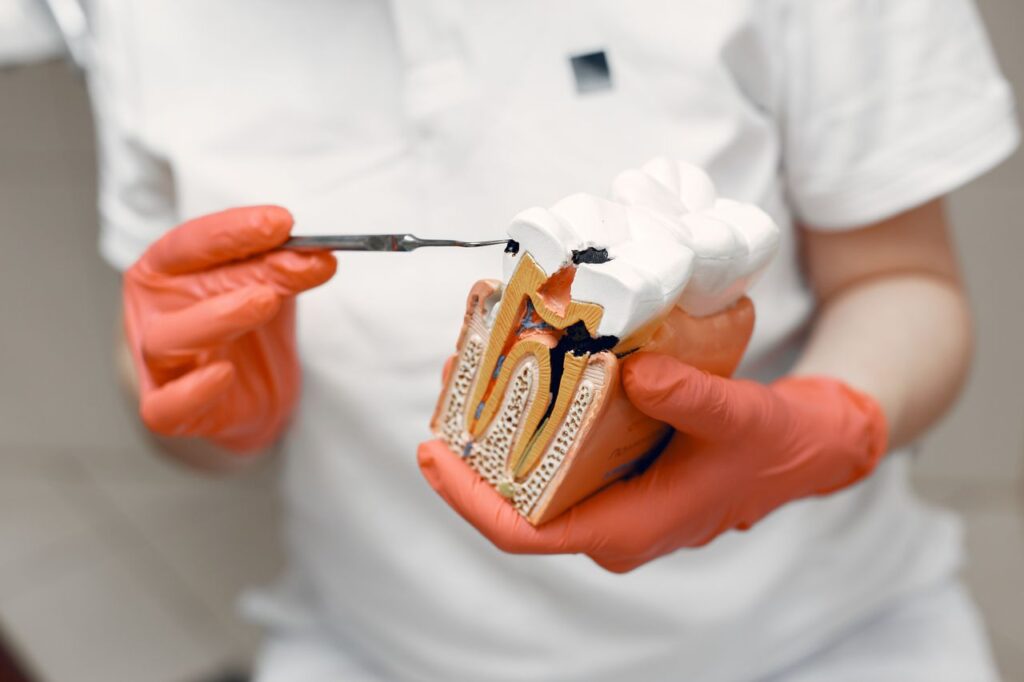
A tooth extraction is one of the most common dental procedures in the world, and with modern local anaesthesia it is usually quick and close to painless. Most patients are back to normal routines within 2 to 3 days.
Still, the word “extraction” makes many people nervous. You may be wondering if you really need it, whether it will hurt, and what you can eat afterwards. This guide answers all of that in plain language.
The need is real. According to the WHO Global Oral Health Status Report, about 3.5 billion people live with oral disease. Untreated tooth decay alone affects around 2.5 billion people, and severe gum disease, a leading cause of tooth loss, affects about 1 billion. These are the same two problems that lead to most extractions.
Quick answer: tooth extraction at a glance
| Question | Short answer |
| How long does it take? | 20 to 40 minutes for a simple extraction; 45 to 90 minutes for a surgical one |
| Does it hurt? | You feel pressure, not sharp pain, thanks to local anaesthesia |
| When can I eat? | Soft, cool foods after the numbness wears off (about 2 to 3 hours) |
| When can I go back to work? | Usually the next day; 2 to 3 days after surgical or wisdom tooth removal |
| How long does the gum take to heal? | 1 to 2 weeks for the gum; 3 to 6 months for the bone underneath |
| Biggest risk to avoid | Dry socket: no smoking, straws or spitting for 72 hours |
At Tamyuz Dental Clinic, a trusted dental clinic in Salalah, every extraction starts with a full examination and an X-ray. We only remove a tooth when saving it is not the better option for you.
What Is a Tooth Extraction?
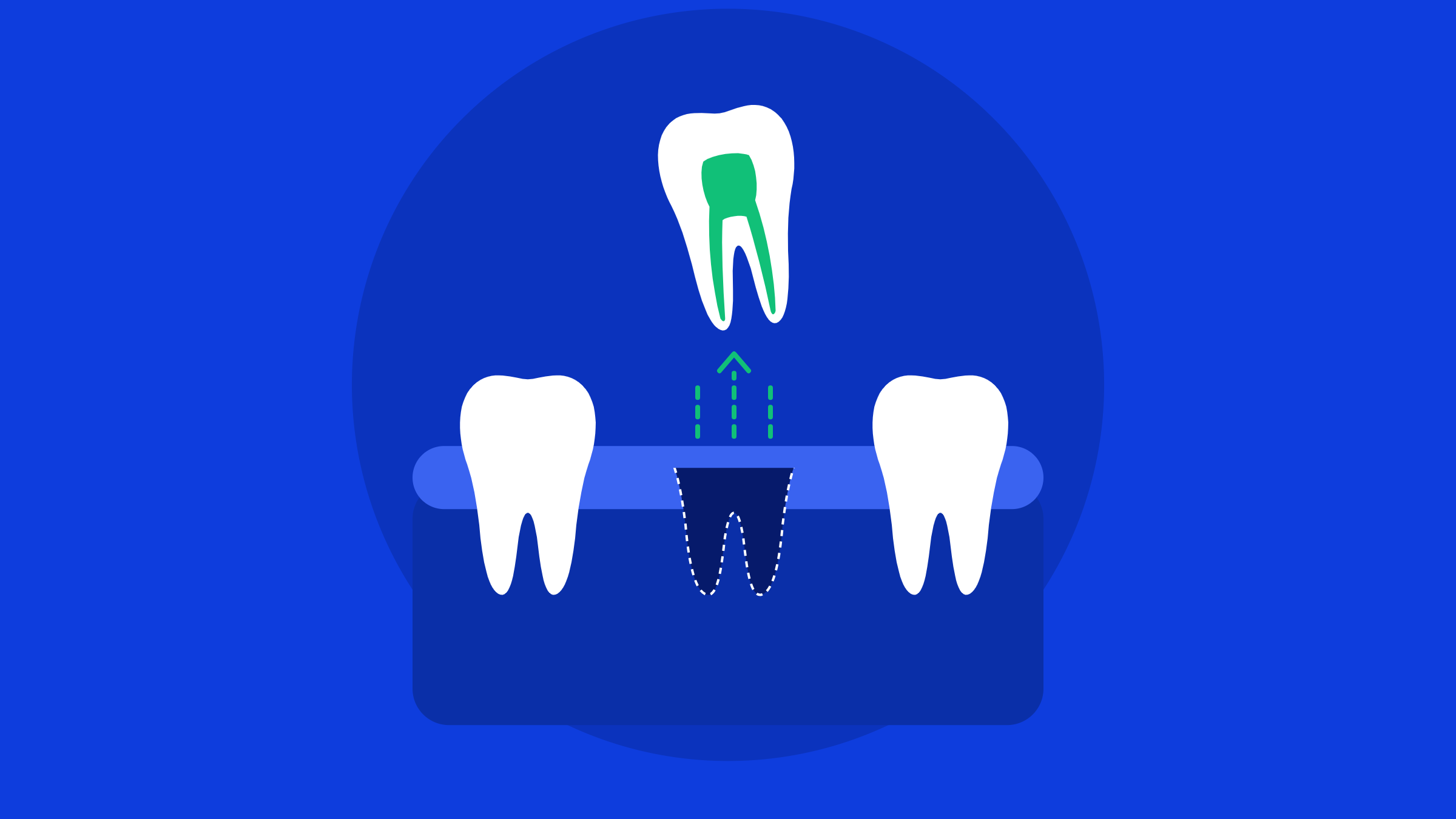
A tooth extraction is the removal of a tooth from its socket in the jawbone. In Arabic it is called خلع الاسنان. Dentists use it when a tooth is too damaged, infected or crowded to keep safely.
There are two main types.
| Simple extraction | Surgical tooth extraction | |
| Used for | Teeth that are fully visible above the gum | Broken, impacted or hidden teeth, including many wisdom teeth |
| How it works | The tooth is loosened and lifted out with dental instruments | A small cut is made in the gum; the tooth may be divided into pieces |
| Anaesthesia | Local anaesthesia | Local anaesthesia, sometimes with extra sedation |
| Stitches | Rarely | Often, usually dissolvable |
| Typical recovery | 1 to 3 days | 3 to 7 days |
A surgical tooth extraction sounds bigger than it is. It simply means the dentist needs better access to the tooth. Most surgical extractions are still done in the dental chair with the patient fully awake and comfortable.
Book your dental checkup in Salalah.
When Does a Tooth Need to Be Extracted?
A tooth needs to be extracted when it can no longer be saved with a filling, root canal treatment or crown, or when keeping it would harm nearby teeth. Extraction is usually the last option, not the first.
The most common reasons are:
- Severe tooth decay. When a cavity destroys too much of the tooth, there is nothing left to restore. Decay is the world’s most common health condition, per the WHO.
- Advanced gum disease. Infection can destroy the bone that holds teeth in place, making them loose.
- Impacted wisdom teeth. Teeth that are trapped under the gum can cause pain, swelling and damage to the tooth next to them.
- A cracked or broken tooth. Some fractures run below the gum line and cannot be repaired.
- Failed root canal treatment. In rare cases, an infection returns and the tooth cannot be retreated.
- Crowding before braces. An orthodontist may ask for one or more teeth to be removed to make space.
- A tooth badly damaged in an accident or sports impact.
Signs you may need to see a dentist about extraction
- Severe or throbbing tooth pain that keeps you awake
- Swelling in the gum, face or jaw
- A tooth that feels loose or moves when you bite
- Pus, a bad taste or a pimple-like bump on the gum
- Pain at the back of the mouth when you open wide
- A tooth that has broken into pieces
Not every painful tooth needs to come out. Many teeth that look hopeless can still be saved with root canal treatment. The only way to know is an examination and an X-ray.
Read more in our guide: Signs You Should See a Dentist for Tooth Pain.
Tooth Extraction vs Root Canal Treatment: Which Is Better?
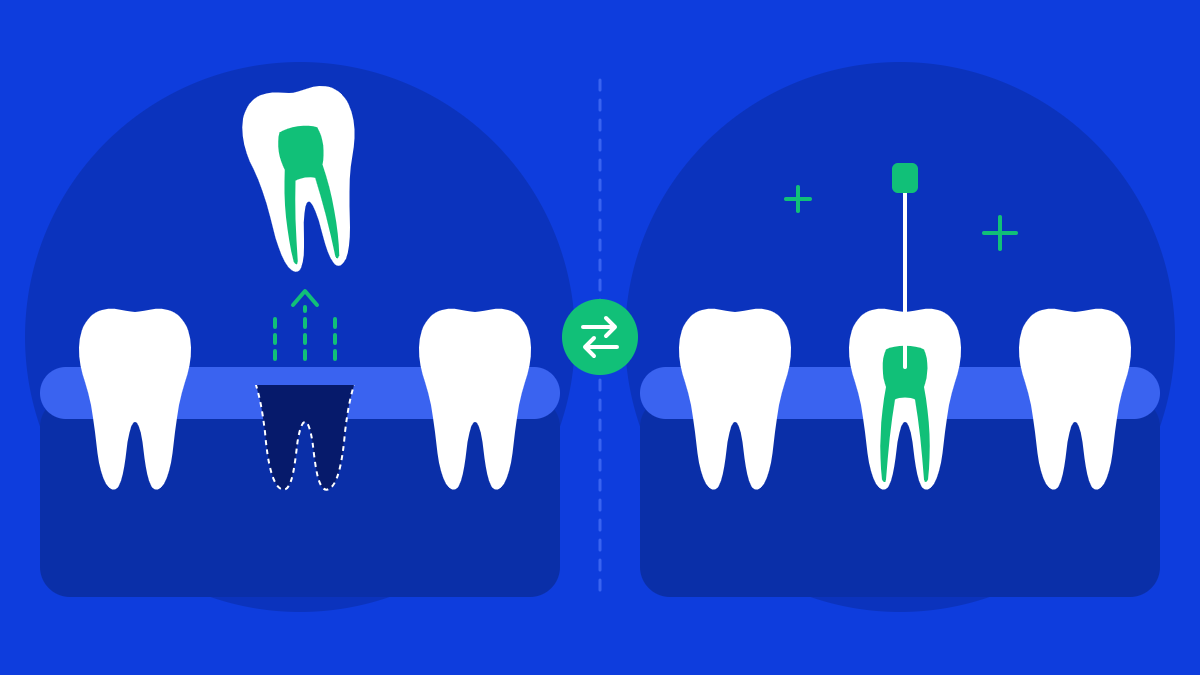
If a tooth can be saved, saving it is almost always the better long-term choice. Your natural tooth keeps your bite stable, protects the jawbone and needs no replacement. Root canal treatment has a high success rate, with studies commonly reporting that most treated teeth survive 10 years or more.
| Factor | Root canal treatment | Tooth extraction |
| Keeps your natural tooth | Yes | No |
| Number of visits | 1 to 3 visits | Usually 1 visit |
| Cost today | Higher (often plus a crown) | Lower |
| Long-term cost | Usually lower | Can rise if the gap needs replacing |
| Effect on nearby teeth | None | Teeth can drift into the gap over time |
| Best for | Infected teeth with healthy roots and enough structure | Teeth too broken, loose or impacted to restore |
At Tamyuz, if your tooth can be saved, we will tell you. Learn more on our Root Canal Treatment in Salalah page, or read Root Canal vs Tooth Extraction: What’s the Difference?
Wisdom Tooth Extraction: Upper and Lower
Wisdom teeth are the last molars to come in, usually between ages 17 and 25. Many jaws simply do not have room for them, so they get stuck (impacted), grow at an angle or only partly break through the gum.
You do not need to remove a wisdom tooth just because you have one. Removal is advised when it causes pain, repeated gum infections, decay, cysts or damage to the tooth in front of it.
Upper wisdom tooth extraction is usually simpler and heals faster than lower. The upper jawbone is softer, and the roots are often easier to reach. Lower wisdom teeth sit in denser bone and close to a nerve, so they more often need a surgical approach and a little more recovery time.
Before any wisdom tooth removal at Tamyuz, we take an X-ray to check the root shape, the angle of the tooth and its distance from nearby nerves and sinuses. That way you know exactly what to expect before the day of treatment.
Read: When Do You Need a Root Canal Treatment?
What Happens During a Tooth Extraction
A simple tooth extraction takes 20 to 40 minutes from start to finish. Here is what happens, step by step.
- Consultation and X-ray. Your dentist examines the tooth, takes an X-ray and reviews your medical history and medicines.
- Treatment plan. We explain whether the tooth can be saved, what type of extraction you need, and the cost before anything begins.
- Local anaesthesia. A numbing gel is applied first, then a small injection. Within a few minutes, the area is completely numb.
- Loosening the tooth. The dentist gently widens the socket and loosens the tooth from the ligament that holds it.
- Removing the tooth. The tooth is lifted out. For a surgical extraction, a small opening is made in the gum, and the tooth may be removed in sections.
- Cleaning and closing. The socket is cleaned. Stitches are placed if needed.
- Gauze and aftercare. You bite on a gauze pad to help a blood clot form. We give you written aftercare instructions before you leave.
Before your appointment, tell your dentist if you:
- Take blood thinners such as aspirin, warfarin or clopidogrel
- Have diabetes, heart disease or high blood pressure
- Are pregnant or breastfeeding
- Have allergies to any medicine or anaesthetic
- Have had bisphosphonate treatment for bone health
Tip: Eat a light meal before your visit, since you will not be able to chew normally for a few hours afterwards.
Does Tooth Extraction Hurt?
No, the extraction itself should not hurt. Local anaesthesia blocks pain signals completely, so most patients feel only pressure and gentle pushing. If you feel any sharp pain, tell your dentist and they will add more anaesthetic.
Pain after tooth extraction
Some soreness after the numbness wears off is normal. It usually peaks in the first 24 to 72 hours and then fades steadily each day.
- Mild discomfort is common after a simple extraction and is usually managed with over-the-counter pain relief your dentist recommends.
- Moderate discomfort and swelling are more likely after surgical or lower wisdom tooth removal.
- Pain that gets worse after day 3, rather than better, is not normal. It can be a sign of dry socket and needs a check-up.
If dental anxiety is holding you back, tell us when you book. Our team will take things at your pace, explain each step and pause whenever you need. For more detail, read Does Tooth Extraction Hurt?
Tooth Extraction Recovery: Day-by-Day Timeline
Most people feel back to normal within 3 to 4 days after a simple extraction and within 1 week after surgical removal. The gum closes in about 2 weeks, while the bone underneath keeps healing for 3 to 6 months.
| Time after extraction | What is normal | What to do |
| First hour | Bleeding and numbness | Bite firmly on the gauze for 30 to 45 minutes |
| First 24 hours | Light oozing, mild pain, some swelling | Rest, use a cold pack on the cheek, eat soft cool food |
| Days 2 to 3 | Swelling peaks, then starts to go down | Start gentle warm salt-water rinses, keep eating soft foods |
| Days 4 to 7 | Pain and swelling fade; stitches may dissolve | Slowly return to normal foods, chew on the other side |
| Weeks 1 to 2 | Gum tissue closes over the socket | Normal routine, normal brushing with care |
| Months 3 to 6 | Bone fills in the socket | Plan your tooth replacement if needed |
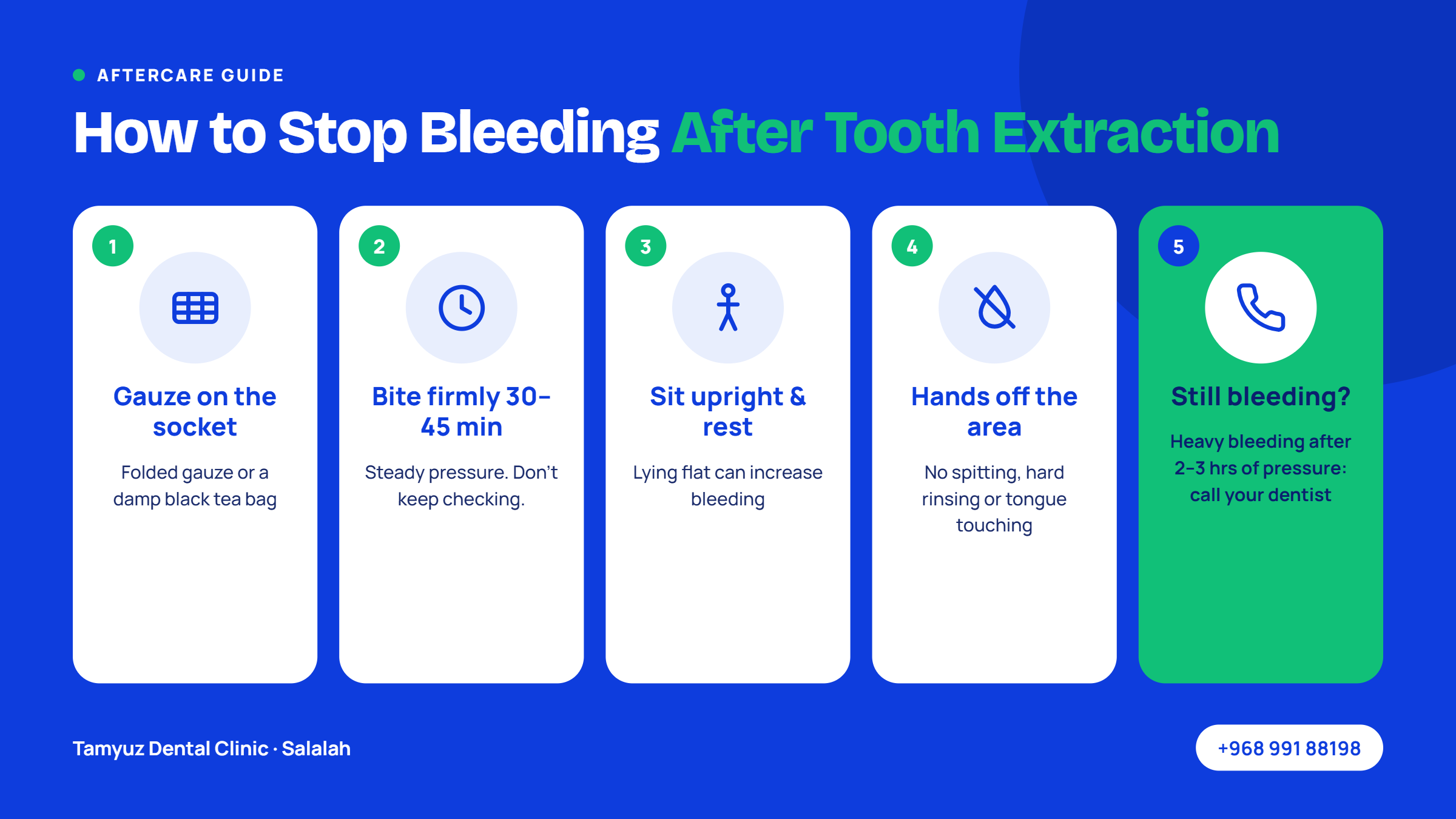
How to stop bleeding after tooth extraction
- Fold a clean gauze pad, or a damp black tea bag, and place it over the socket.
- Bite down firmly and steadily for 30 to 45 minutes. Do not keep checking it.
- Sit upright and rest. Lying flat can increase bleeding.
- Avoid spitting, rinsing hard or touching the area with your tongue.
- If heavy bleeding continues after 2 to 3 hours of firm pressure, call your dentist.
The tannic acid in black tea helps blood clot, which is why the tea bag trick works. A little pink saliva for 24 hours is normal and is not a reason to worry.
Read the full guide: How Long Does It Take to Recover After Tooth Extraction?
Instructions After Tooth Extraction: What to Eat and What to Avoid
For the first 24 to 48 hours, eat soft, cool or lukewarm foods and chew on the opposite side. Your goal is simple: protect the blood clot in the socket, because it is the foundation of healing.
After tooth extraction food: what you can eat
| First 24 hours | Days 2 to 3 | Days 4 to 7 |
| Cool yoghurt or laban | Soft scrambled eggs | Soft rice and well-cooked lentils (dal) |
| Smooth soups, lukewarm | Mashed potatoes | Soft fish |
| Hummus or mutabal | Soft cooked oats | Soft cooked vegetables |
| Fruit smoothies (with a spoon) | Mashed banana or avocado | Pasta and soft bread |
| Ice cream or custard | Cottage cheese | Return to normal food slowly |
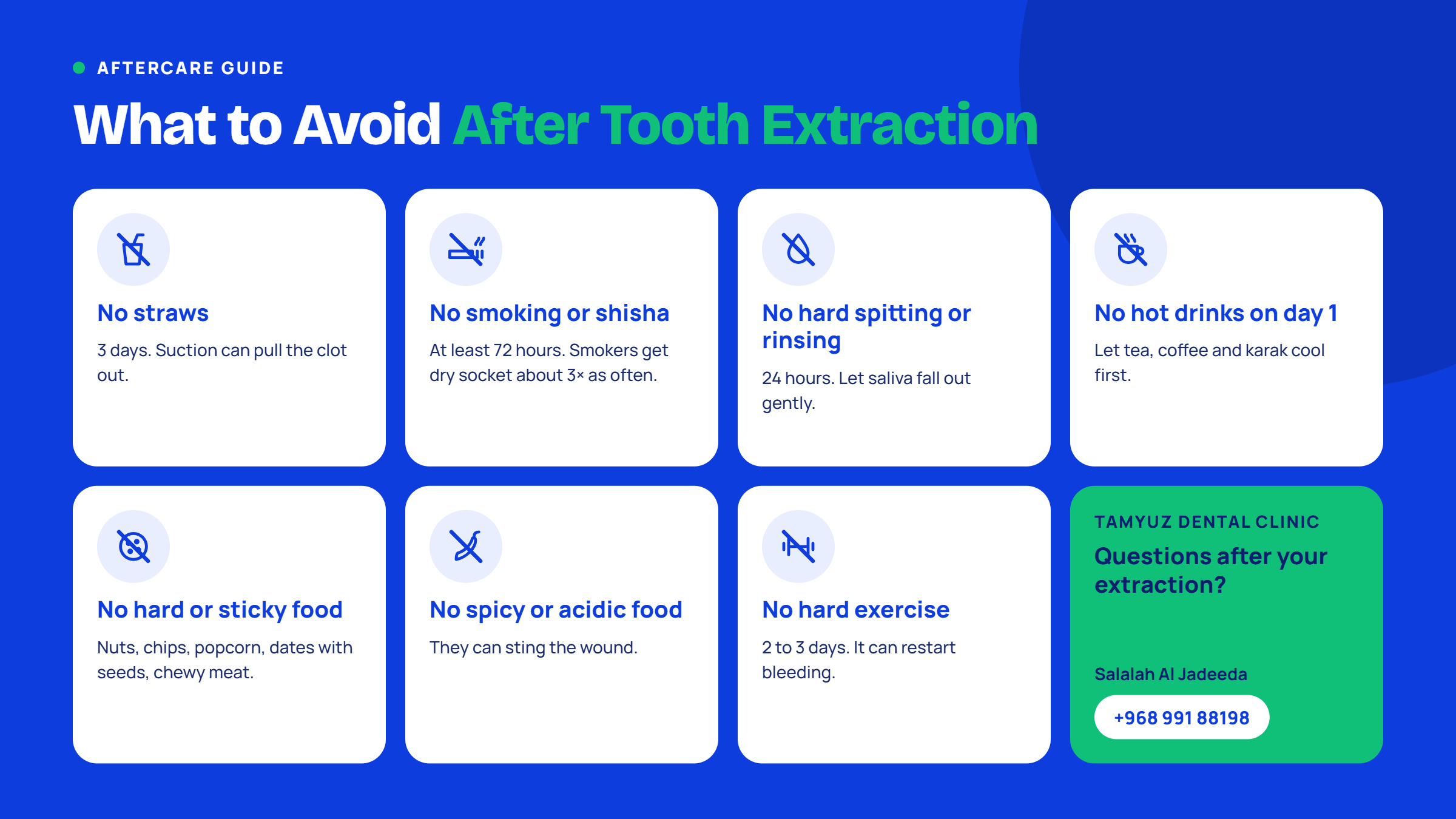
What to avoid after tooth extraction
- Straws for 3 days. The suction can pull the clot out of the socket.
- Smoking and shisha for at least 72 hours. Smokers get dry socket about three times as often as non-smokers (12% vs 4% in one regional study).
- Spitting or rinsing hard for 24 hours. Let saliva fall out gently instead.
- Hot drinks on day 1. Let tea, coffee and karak cool down first.
- Hard, crunchy or sticky food. Nuts, chips, popcorn, dates with seeds and chewy meat can get stuck in the socket.
- Spicy and acidic food. These can sting the wound.
- Hard exercise for 2 to 3 days. It can restart bleeding.
Daily care tips
- Rest with your head raised on an extra pillow the first night.
- Use a cold pack on your cheek, 15 minutes on and 15 minutes off, for the first 24 hours.
- From day 2, rinse gently with warm salt water (half a teaspoon of salt in a glass of water) after meals.
- Keep brushing your other teeth, but avoid the extraction site for the first 24 hours.
- Take any medicine exactly as your dentist prescribed.
Fasting tip: If your extraction falls during Ramadan, ask us about timing. An evening appointment after Iftar lets you take pain relief and drink fluids during the most sensitive first hours.
See the full lists in What to Eat After Tooth Extraction and What to Avoid After Tooth Extraction.
Tooth Extraction Complications: Dry Socket and Other Risks
Serious tooth extraction complications are uncommon. The most frequent one is dry socket, and most cases can be prevented with good aftercare.
What is dry socket?
Dry socket (alveolar osteitis) happens when the blood clot falls out or dissolves too early, leaving the bone exposed. Research shows it affects 1% to 5% of routine extractions and up to 30% of surgically removed wisdom teeth.
Signs of dry socket:
- Pain that gets worse 2 to 4 days after the extraction, instead of better
- Pain spreading to the ear, eye or neck on the same side
- An empty-looking socket, or visible whitish bone
- Bad breath or an unpleasant taste
Dry socket is painful but very treatable. Your dentist cleans the socket and places a soothing dressing, and relief often comes within hours.
Other possible complications
| Complication | How common | What it feels like |
| Infection | Uncommon | Swelling, fever or pus after day 3 |
| Prolonged bleeding | Uncommon, higher with blood thinners | Bleeding that continues past a few hours of pressure |
| Nerve irritation | Rare, mostly lower wisdom teeth | Tingling or numbness in the lip, chin or tongue, usually temporary |
| Sinus opening | Rare, upper back teeth only | Air or fluid passing between mouth and nose |
When to call your Dentist
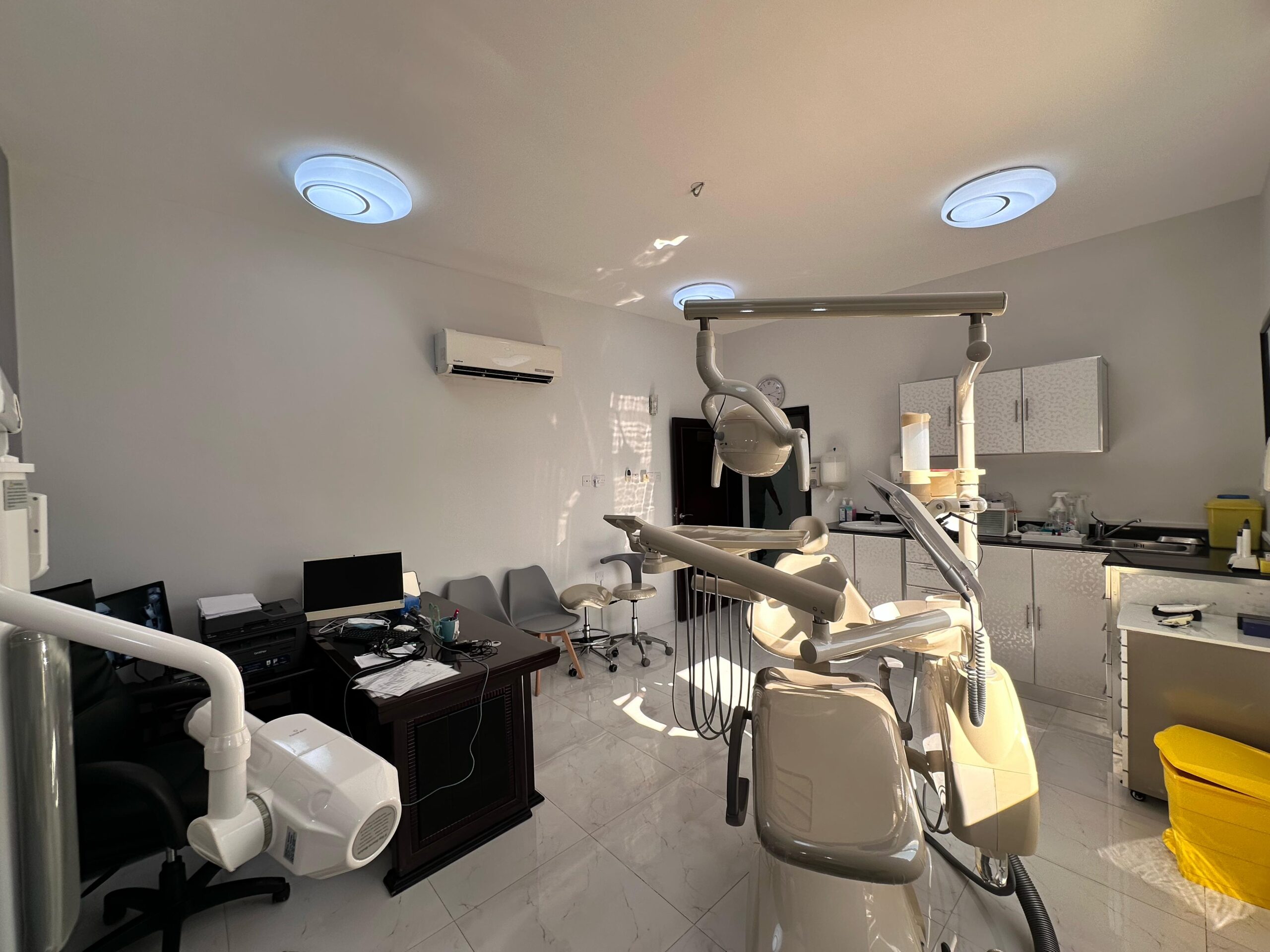
Call Tamyuz Dental Clinic straight away if you notice heavy bleeding that will not stop, a fever, swelling that grows after day 3, pus, or numbness that lasts beyond 24 hours. Go to the emergency department if you have trouble breathing or swallowing.
Should You Replace an Extracted Tooth?
If the missing tooth is a wisdom tooth, you usually do not need to replace it. For any other tooth, replacing it is worth considering. Over time, nearby teeth can tilt into the gap, your bite can shift and the jawbone in that area can shrink.
The three common replacement options are:
| Option | What it is | Good to know |
| Dental implant | A titanium post placed in the jawbone, topped with a crown | Closest to a natural tooth; needs healthy bone |
| Dental bridge | A false tooth held by crowns on the teeth either side | Fixed in place; neighbouring teeth are reshaped |
| Removable denture | A plate with one or more false teeth | Lowest cost; removed for cleaning |
The right choice depends on your bone, your budget and the health of nearby teeth. Talk it through with your dentist at your follow-up visit. Many people also find that a zirconia or porcelain crown can save a cracked tooth before extraction is ever needed.
Learn more on our Zirconia & Porcelain Crowns in Salalah page.
Tooth Extraction Cost in Salalah
The cost of a tooth extraction depends on how complex it is. The cost of a normal tooth extraction is 20 OMR, while a surgical extraction costs between 30 and 40 OMR at Tamyuz Dental Clinic. Dental treatment charges in Oman vary from clinic to clinic, so it is always worth asking for a clear quote before treatment.
The main factors that affect the price are:
- Type of extraction. A simple extraction costs less than a surgical one.
- Which tooth. Front teeth have one root; molars have two or three, and wisdom teeth can be impacted.
- X-rays needed. A standard X-ray is usually enough; complex cases may need more imaging.
- Number of teeth. Removing several teeth in one visit can be more cost-effective.
- Many plans cover part of the cost of a medically needed extraction.
At Tamyuz, you get a clear price after your examination and before any treatment begins. No surprises.
Choosing a Dentist in Salalah for Your Extraction
Whether you search “dentist near me” or “عيادة اسنان“, the right dental clinic in Salalah should offer:
- An X-ray before every extraction
- A dentist who tries to save the tooth first
- Clear pricing before treatment
- Written aftercare instructions and easy follow-up
- Strict sterilisation and infection control
- Patience with nervous patients
Prefer a female dentist? (طبيبة أسنان)
Yes. Tamyuz Dental Clinic has a female dentist, and you can request her when you book. Many of our patients feel more comfortable this way, especially for longer appointments. Just mention it when you call or message us.
Tooth extraction while pregnant
If an extraction is needed during pregnancy, the second trimester (weeks 14 to 27) is usually the most comfortable and safest time. Local anaesthesia is commonly used in pregnancy, and an X-ray can be taken with a protective lead apron. Always tell your dentist you are pregnant, and urgent infections should never be left untreated.
Book your dental checkup in Salalah.
Frequently Asked Questions About Tooth Extraction
Q: How long does a tooth extraction take?
A simple extraction takes 20 to 40 minutes. A surgical or wisdom tooth extraction can take 45 to 90 minutes.
Q: Can I drive home after a tooth extraction?
Yes, after a standard extraction with local anaesthesia. If you receive sedation, you will need someone to drive you.
Q: When can I eat after a tooth extraction?
Wait until the numbness wears off, usually 2 to 3 hours. Then start with soft, cool foods such as yoghurt, soup or mashed potatoes.
Q: How long should I bite on the gauze?
Bite firmly for 30 to 45 minutes. Replace it with a fresh pad if bleeding continues.
Q: When can I brush my teeth?
Brush your other teeth the same night. Avoid the extraction area for the first 24 hours, then brush it gently.
Q: When can I smoke after a tooth extraction?
Wait at least 72 hours, and longer is better. Smoking is one of the biggest causes of dry socket.
Q: Is it normal to have swelling?
Yes. Swelling usually peaks on day 2 or 3 and then goes down. Swelling that grows after day 3 should be checked.
Q: Can a tooth extraction be done on the same day?
Often, yes, if the tooth is causing pain and there is no active swelling that needs treatment first. Your dentist will advise after the X-ray.
Q: Do I need antibiotics after a tooth extraction?
Not always. Most simple extractions heal well without them. Your dentist prescribes them only when there is infection or a specific medical reason.
ملخص باللغة العربية: خلع الاسنان في صلالة
خلع الاسنان إجراء شائع وآمن، ويتم تحت تخدير موضعي فلا تشعر بألم أثناء العلاج، بل بضغط خفيف فقط. يستغرق الخلع البسيط من 20 إلى 40 دقيقة، ويعود معظم المرضى إلى حياتهم الطبيعية خلال يومين إلى ثلاثة أيام.
بعد الخلع، اضغط على الشاش لمدة 30 إلى 45 دقيقة، وتناول أطعمة طرية وباردة، وتجنب التدخين والشيشة والمصاصة لمدة 72 ساعة على الأقل لحماية الجلطة الدموية.
في عيادة تميز لطب الأسنان في صلالة، نحاول دائمًا إنقاذ السن أولًا قبل اللجوء إلى الخلع. ولراحتك، تتوفر لدينا طبيبة أسنان يمكنك طلبها عند الحجز.
Sources
- WHO Global Oral Health Status Report 2022, via UN News
- Dry Socket Prevalence and Risk Factors in Third Molar Extractions, PMC
- Dry Socket: Frequency, Clinical Picture and Risk Factors, Open Dentistry Journal
Medically reviewed by Dr. Yaseer El Kholy | 1st October, 2026